
You are using an out of date browser. It may not display this or other websites correctly.
You should upgrade or use an alternative browser.
You should upgrade or use an alternative browser.
The description of fairies in the Indian stories.
- Thread starter tufguy
- Start date
- Views : 2,077
- Status
- Not open for further replies.
- Joined
- Feb 4, 2014
- Location
- India
- Member Type
- Student or Learner
- Native Language
- Hindi
- Home Country
- India
- Current Location
- India
Where did you find this sentence? In what context? What are we supposed to check?
Is it correct? I didn't find it anywhere it is my own sentence.

- Joined
- Jun 20, 2010
- Member Type
- Retired English Teacher
- Native Language
- British English
- Home Country
- England
- Current Location
- England
I didn't find it anywhere. It is my own sentence.
Why did you write it? Is it part of a longer piece of writing?
Please don't post any new questions until all your current ones have been dealt with.
- Joined
- Feb 4, 2014
- Location
- India
- Member Type
- Student or Learner
- Native Language
- Hindi
- Home Country
- India
- Current Location
- India
Yes, I do want to say it.
- Joined
- Feb 4, 2014
- Location
- India
- Member Type
- Student or Learner
- Native Language
- Hindi
- Home Country
- India
- Current Location
- India
Why did you write it? Is it part of a longer piece of writing?
Please don't post any new questions until all your current ones have been dealt with.
No, it is not a part of a longer piece of writting. I think I won't be posting questions for few days after these questions have been dealt with.
- Joined
- Feb 4, 2014
- Location
- India
- Member Type
- Student or Learner
- Native Language
- Hindi
- Home Country
- India
- Current Location
- India
In Indian stories, fairies are depicted as white girls.
tufguy
Your sentence makes people wonder what you mean by "white girls".
By white girls I mean white girls. I want to say in Indian fairy stories that are meant for children that are told to them at bed time like usually children ask you to tell them stories. Most of the stories do have fairies in them so when they tell them these stories they give the description of the fairy as well who is the protagonist like there was a place there lived a fairy and they tell something like "she was very beautiful, she was very fair, she had red cheeks, blonde hair, blue eyes, so it is clearly a description of a white girl, Indian girls are not like this.

- Joined
- May 11, 2015
- Member Type
- English Teacher
- Native Language
- English
- Home Country
- United States
- Current Location
- United States
I suppose 'white' works when the context makes it clear you're referring to race or ethnicity, but when you're speaking of mythology and fantasy, it doesn't. It could easily be taken literally.
Here are four 'white' women. Two are 'regular' people, while two of them are actresses portraying fictional characters.
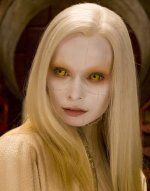


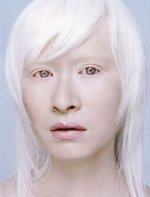
Then you have albino people, who can be of any race. The last woman is of Asian ethnicity.
To remove ambiguity, I suggest you describe your fairies as something like 'fair skinned and light haired'. If you want them to be blonde, call them 'flaxen haired', if you're thinking of them as looking like the St. Pauli girl logo.

Here are four 'white' women. Two are 'regular' people, while two of them are actresses portraying fictional characters.
Then you have albino people, who can be of any race. The last woman is of Asian ethnicity.
To remove ambiguity, I suggest you describe your fairies as something like 'fair skinned and light haired'. If you want them to be blonde, call them 'flaxen haired', if you're thinking of them as looking like the St. Pauli girl logo.
Last edited:
ChinaDan
Member
- Joined
- Sep 6, 2016
- Member Type
- English Teacher
- Native Language
- American English
- Home Country
- United States
- Current Location
- China
I think the two two-word adjectives should be hyphenated - fair-skinned and flaxen-haired.
Interesting. The majority of the dictionary listings have it as two words.
From it there descended two men - one flaxen haired and tall, and the other dark haired and of slighter build.
-- Nikolai Gogol, Dead Souls
-- Nikolai Gogol, Dead Souls
And then Purdue OWL says:
Use a hyphen to join two or more words serving as a single adjective before a noun:
a one-way street
chocolate-covered peanuts
well-known author
However, when compound modifiers come after a noun, they are not hyphenated:
The peanuts were chocolate covered.
The author was well known.
Source
a one-way street
chocolate-covered peanuts
well-known author
However, when compound modifiers come after a noun, they are not hyphenated:
The peanuts were chocolate covered.
The author was well known.
Source
This would suggest the are not hyphenated here, because they come after the noun.
- Status
- Not open for further replies.
Similar threads
- Replies
- 6
- Views
- 364

- Locked
- Replies
- 33
- Views
- 3K

- Replies
- 1
- Views
- 2K
- Replies
- 3
- Views
- 1K

Ask a Teacher
If you have a question about the English language and would like to ask one of our many English teachers and language experts, please click the button below to let us know:
(Requires Registration)