
The given pie charts provide informationabout ...

Status
Not open for further replies.

Ikigai

Member
Joined
Aug 30, 2024
Member Type
Student or Learner
Native Language
Vietnamese
Home Country
Vietnam
Current Location
Vietnam
can someone help me evaluate my writing task 1

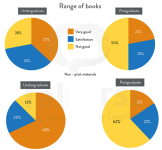
The given pie charts provide informationabout the percentage of survey’s consequences where undergraduates and postgraduates were asked to tell about the quantity of books as well as non-printed resources in school library.

Overall, the range of books in schools however reflect the reverse to each other and the same tendency goes on to non-print materials.Therefore, those pie charts show the variations of contribution in each of them.

Regarding the data of the amount of books in both,the very-good and the satisfaication in undergraduates contribute the most and make up significantly over 62% of the chart which are 35% and 37% respectively,while that in postgraduates just experience the least in each and make about a half in sum. Then the not-good is recorded to overtake exactly 50% but that in undergraduates is lowestly 28%.

In terms of the diagram of the not-printed materials, the very-good in undergraduates account for 68% and take over two-thirds of the pie chart while that in postgraduates take up 12% which is considered to be the least.By contrast, the proportion of not-good in postgraduates make up the most ,close to 60% when that in undergraduates is around its lowest.Moreover, the satisfication in both figures is similar to each other as well.

dwed.png
 
Last edited:
I have difficulty understanding the first paragraph. What is the purpose of the survey?
Is this a school/college assignment?
 
What does "tell about the quantity of books" mean?
 
This is practice for an IELTS Writing Task 1. We need to see the pie charts in order to give proper feedback. I suggest you repost the piece along with the diagram to the Editing and Writing Topics section of the forum, where perhaps teechar might give you some professional feedback.
 
Hi @Ikigai and welcome to the forum.
Please post an image of the diagram that came with the task.

Note that I have moved your thread to our Writing and Editing section of the forum.
I have attached the image. Thanks a lot .
I have difficulty understanding the first paragraph. What is the purpose of the survey?
Is this a school/college assignment?
I have updated it. I'm glad that you help me :3
 
This is practice for an IELTS Writing Task 1. We need to see the pie charts in order to give proper feedback. I suggest you repost the piece along with the diagram to the Editing and Writing Topics section of the forum, where perhaps teechar might give you some professional feedback.
That's my bad. This is my first time i have posted on this forum. Thanks btw:3.
 
What does "tell about the quantity of books" mean?
This is just my first glance. I'd notice that . Looking forward to hearing from you !
 
The reason I asked about that phrase is that I'd never seen it before, and I don't know what it means.
 
The given pie charts provide information space here about the percentage of the survey’s consequences where undergraduates and postgraduates were asked to tell about the quantity of books as well as non-printed resources in school library.

Overall, the range of books in schools, however, reflect the reverse to of each other and the same tendency goes on to non-print materials. space here Therefore, those pie charts show the variations of contribution in each of them.

Regarding the data of the amount of books in both, space here the very-good and the satisfaication satisfaction in undergraduates contribute the most and make up significantly over 62% of the chart which are 35% and 37% respectively, space here while that in postgraduates just experience the least in each and make up about a half in of the sum. Then the not-good is recorded to overtake exactly 50% but that in undergraduates is lowestly lowest, at 28%.

In terms of the diagram of the not-printed materials, the very-good in undergraduates account for 68% and takes up over two-thirds of the pie chart, while that in postgraduates take up 12% which is considered to be the least. space here By contrast, the proportion of not-good in postgraduates make up the most, close to 60%, when while that in undergraduates is around its lowest. space here Moreover, the satisfication satisfaction is similar in both figures. is similar to each other as well.
Note my corrections above. Remember to put a space after every comma and full stop. I've made some other changes but not to the technical content (because I don't really understand any of it!)

I have attached the image. Thanks a lot.
Don't put a space before a full stop.
I have updated it. I'm glad that you helped me.
Note my corrections above.
This means nothing. Don't try to make your own emojis here. If you really need one, click on the :)icon in the toolbar and choose the appropriate one.
This is just my first glance.
I don't know what that means.
I'd notice that.
I think you mean "I hadn't noticed that".
I'm looking forward to hearing from you!
Always write complete sentences. Don't put a space before an exclamation mark.
Oh, okay.
Note my corrections to your punctuation above.
 
1- You wrote 205 words. That is too long for task 1. You simply do not have time in the exam, and it also tells the examiner that you are not able to summarize! Aim for around 150-170.
2- Please give us also the legend or task question as given.
3- "Provide information about" is weak. Every diagram provides some kind of information! Use something like "compare" or "outline".
4- Write clear concise sentences. By unnecessarily complicating your sentences or by making them too long, you run the risk of making them ungrammatical and difficult to understand. That frustrates the examiner and means a low score for you. For example, the sentences below are incomprehensible!
Overall, the range of books in schools however reflect the reverse to each other and the same tendency goes on to non-print materials.
Regarding the data of the amount of books in both,the very-good and the satisfaication in undergraduates contribute the most and make up significantly over 62% of the chart which are 35% and 37% respectively,while that in postgraduates just experience the least in each and make about a half in sum.
Here are two possible openings to your two main paragraphs:
"Regarding student satisfaction with the range of books available, ..."
and
"In terms of non-printed materials, ...".
Amend your text and repost it below. Don't forget please to give us the task question.
 
It cannot be good to use words and phrases you do not understand. When you do that you can be pretty sure the reader won't know what you are talking about (because you don't!).
 
1- You wrote 205 words. That is too long for task 1. You simply do not have time in the exam, and it also tells the examiner that you are not able to summarize! Aim for around 150-170.
2- Please give us also the legend or task question as given.
3- "Provide information about" is weak. Every diagram provides some kind of information! Use something like "compare" or "outline".
4- Write clear concise sentences. By unnecessarily complicating your sentences or by making them too long, you run the risk of making them ungrammatical and difficult to understand. That frustrates the examiner and means a low score for you. For example, the sentences below are incomprehensible!


Here are two possible openings to your two main paragraphs:
"Regarding student satisfaction with the range of books available, ..."
and
"In terms of non-printed materials, ...".
Amend your text and repost it below. Don't forget please to give us the task question.
The pie charts show the results of a survey in which undergraduates and postgraduates were asked about the range of books and non-printed materials in their school library.

Summarize the information by selecting and reporting the main features, and make comparisons where relevant.


Here you go.
 
Note my corrections above. Remember to put a space after every comma and full stop. I've made some other changes but not to the technical content (because I don't really understand any of it!)


Don't put a space before a full stop.

Note my corrections above.

This means nothing. Don't try to make your own emojis here. If you really need one, click on the :)icon in the toolbar and choose the appropriate one.

I don't know what that means.

I think you mean "I hadn't noticed that".

Always write complete sentences. Don't put a space before an exclamation mark.

Note my corrections to your punctuation above.
Thanks to your corrections
 
1- You wrote 205 words. That is too long for task 1. You simply do not have time in the exam, and it also tells the examiner that you are not able to summarize! Aim for around 150-170.
2- Please give us also the legend or task question as given.
3- "Provide information about" is weak. Every diagram provides some kind of information! Use something like "compare" or "outline".
4- Write clear concise sentences. By unnecessarily complicating your sentences or by making them too long, you run the risk of making them ungrammatical and difficult to understand. That frustrates the examiner and means a low score for you. For example, the sentences below are incomprehensible!


Here are two possible openings to your two main paragraphs:
"Regarding student satisfaction with the range of books available, ..."
and
"In terms of non-printed materials, ...".
Amend your text and repost it below. Don't forget please to give us the task question.
and also i wonder if you could give me the mark that i would get for my writing task 1.
things that i need to improve as well, please.
 
Thanks to your corrections
and also i wonder if you could give me the mark that i would get for my writing task 1.
things that i need to improve as well, please.

You're welcome. I'm still waiting for the new version of your summary. Post it below, and I'll take a look at it.
 
You're welcome. I'm still waiting for the new version of your summary. Post it below, and I'll take a look at it.


The given pie chart outlined the proportion of the survey findings which undergraduates and postgraduates had been questioned about the quantity of physical books as well as e-book resources in their school library.

Overall, the proportion of the very-good group outweighed the rest with both range of books and non-print materials for the undergraduates while the not-good group was on top with the two pie charts that dedicated non-print materials and range of books for the postgraduates.


Regarding the data for the number of books in both objects, the very-good and the satisfaction in undergraduates contributed the most, made up significantly over 62% of the chart, were 35% and 37% respectively, while that in postgraduates just experienced the least in each, made about half of the sum. Then the not-good recording to overtake exactly 50% but that in undergraduates was lowest at 28%.


In terms of the figures for the non-print materials, the very-good in undergraduates accounted for 68% took up over two-thirds of the pie chart, while that in postgraduates took up 12% which is considered to be the least. By contrast, the percentage of not-good in postgraduates made up the most, closed to 60%, while that in undergraduates is around its lowest. Moreover, the satisfaction is similar in both figures.


Here you go. Thanks btw
 
The [ 1] given four pie charts [ 2] outline [ 3] d the proportion of the survey findings levels of student satisfaction which (undergraduates and postgraduates) had been questioned about with the quantity range of physical books as well as e-book [ 4] non-print resources in their school library.

[ 5] Overall, undergraduates were more satisfied than postgraduates, and that was especially true for non-print materials. the proportion of the very-good group outweighed the rest with both range of books and non-print materials for the undergraduates while the not-good group was on top with the two pie charts that dedicated non-print materials and range of books for the postgraduates.

[ 6] Regarding the data for the number of printed books, only 28% of undergraduates said they were dissatisfied, as opposed to 35% who were satisfied and 37% who considered the range very good.
---------------------------------

[ 1]: Avoid unnecessary filler words such as "given".
[ 2]: There are four pie charts.
[ 3]: Use the present simple (not the past simple) tense when describing a diagram.
[ 4]: Not all non-print materials are e-books.
[ 5]: Keep the overall statement short and broad. Do not include details in it.
[ 6]: Try to write similar descriptions for the remaining three charts. You can vary the language as you wish, but be mindful to write in a clear and straightforward manner. Post below.
 
Status
Not open for further replies.

Ask a Teacher

If you have a question about the English language and would like to ask one of our many English teachers and language experts, please click the button below to let us know:

(Requires Registration)
Back
Top