
The use of "plan" to talk about the future

Status
Not open for further replies.

Rachel Adams

Key Member
Joined
Nov 4, 2018
Member Type
Student or Learner
Native Language
Russian
Home Country
Georgia
Current Location
Georgia
Hello.

This exercise is from my textbook. Are all of these correct in the right context? I am asking about the fifth sentence. It asks to correct the mistake. I changed it into "I am planning on applying." But if I say "I plan to apply." "I am planning to apply." "I plan on applying." They would be correct too, I think. If "I am planning" suggests arrangement in this context, can I use the simple present in such a sentence? I have asked about the difference between the simple present and progressive, but this situation is a little different.Screenshot_2020-09-05-13-15-32-595_com.facebook.orca.jpg
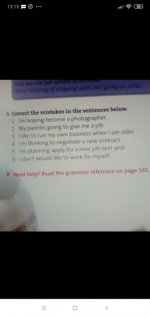
 
Hello.

This exercise is from my textbook. Are all of these correct in the right context?

They are all wrong in any context. That's why the instructions say to correct them.


I am asking about the fifth sentence. It asks to correct the mistake. I changed it into "I am planning on applying." But if I say "I plan to apply," "I am planning to apply," or "I plan on applying," they would be correct too, I think.

Yes, they would.


If "I am planning" suggests arrangement in this context,

I don't know what you mean by "arrangement."


can I use the simple present in such a sentence?

Yes.


I have asked about the difference between the simple present and progressive, but this situation is a little different.
They usually are.
 
I'm guessing the instructions tell you to correct the sentences by adding or changing just one word. If so, adding "to" is what the author is looking for.
 
I thought that too initially, but although it works for sentences 1-3, it doesn't work for 4 or 6.
 
I thought that too initially, but although it works for sentences 1-3, it doesn't work for 4 or 6.

Sorry, what works for sentences 1-3? In what situation would a native speaker say "I plan on applying"? I can understand "I am planning(future arrangements) but not "I plan on applying".
 
Sorry, what works for sentences 1-3? In what situation would a native speaker say "I plan on applying"? I can understand "I am planning(future arrangements) but not "I plan on applying".
You: "Have you heard the restaurant is hiring again?"
Me: "Yes. I plan on applying."

You: "They say Oxford is a good university."
Me: "Yes, they do. That's why I plan on applying."
 
You: "Have you heard the restaurant is hiring again?"
Me: "Yes. I plan on applying."

You: "They say Oxford is a good university."
Me: "Yes, they do. That's why I plan on applying."

Oh, so even the present simple is used to talk about the future.:shock:
 
Frequently.

However, in 'I plan to apply/on applying', the planning is not future. it's the applying that is in the future, just as it is in 'I want/hope/intend/etc to apply'.

I see. Regarding "hope" and "I am hoping", "I plan" "I am planning" the progressive shows limited duration which was previously discussed. Can I use "expect" and "intend" in the same way? "I expect" and "I am expecting", "I intend", and "I am intending" just like "I hope" and "I am hoping"?
 
In terms of duration, I don't see a difference between "I plan" and I'm planning." Both state your present plans. Either way, your plans might change.

But yes, you can use those other words the same way.
 
Frequently.

However, in 'I plan to apply/on applying', the planning is not future. it's the applying that is in the future, just as it is in 'I want/hope/intend/etc to apply'.

How would you explain the use of the verb "plan" in the present simple to ESL students if you were teaching them in a classroom? It's not used to express 'habitual actions' or 'something that is always true', is it?

https://www.usingenglish.com/glossary/present-simple.html
 
. . . I have for years found it more helpful to suggest that you don't need reasons to use the present simple. You use it unless you have a reason to use another tense or aspect.
That sounds right. It's the default tense.
 
Status
Not open for further replies.

Ask a Teacher

If you have a question about the English language and would like to ask one of our many English teachers and language experts, please click the button below to let us know:

(Requires Registration)
Back
Top