
We persuaded/were persuading/tried to persuade (them) for a long time not to do it.

Status
Not open for further replies.
Joined
Apr 8, 2024
Member Type
Student or Learner
Native Language
Russian
Home Country
Russian Federation
Current Location
Russian Federation
Does this sentence say anything about whether the action was successful?
  • We persuaded (them) for a long time not to do it.
It's from here (link - two seconds before the moment).
The original words in Russian did not contain any information on whether the action was successful or not, it was merely a statement of something they were engaged in, maybe it's something more like "We were persuading (them) for a long time not to do it".

The interesting thing is that there are two versions of this! The first one that you can see above is by the translator that Tucker brought with him, while the Kremlin has its own version translated by the Kremlin official translator (link to the second version).

Here's how it reads:
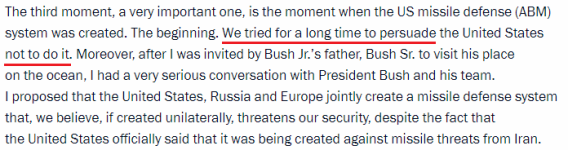
(short) We tried for a long time to persuade ... not to do it.png

Seeing the second version made me wonder if the one done by Tucker's translator was wrong.
 
Thanks for clearing that up!

About this:
You can't persuade someone 'for a long time' because persuading is not a durative action. If you persuade someone, it means you succeed in changing their mind.
After seeing the second version (tried to), I thought that the first one could be used in a different situation to mean "We (successfully) persuaded them for a long time". Like for a long time they (who were persuaded) didn't do it, but then perhaps something happened and after a long time of not doing it, they did it (or started doing it). Could this be a possibility?

An example I came up with:
  • For ten years, the leader of the XYZ cult persuaded his followers to give $100 every day “for a great cause”. and then something like: But after ten years, he lost his power over them.
Could persuading be a durative action in such a context?
 
Last edited:
No. You are trying to change the meaning of that word. He persuaded them to do it. That means he talked them into doing it. It wasn't an ongoing process. If he had to to keep nagging them then they hadn't really been persuaded.
 
You are trying to change the meaning of that word.
No, I'm not. I was just trying to understand if that would work in English.
He persuaded them to do it. That means he talked them into doing it. It wasn't an ongoing process.
OK, I get it, thanks.
If he had to to keep nagging them then they hadn't really been persuaded.
But not this, I don't understand why you would say that. To me, if they did give that money every day for 10 years, they had been persuaded, no? Let's change the sentence, what do you think about these? Do they sound better to you?
  • For ten years, the leader of the XYZ cult was able to persuade his followers to give $100 every day “for a great cause”. and then something like: But after ten years, he lost his power over them.
  • For ten years, the leader of the XYZ cult managed to persuade his followers to give $100 every day “for a great cause”. and then something like: But after ten years, he lost his power over them.
  • Over [the course of] ten years, the leader of the XYZ cult persuaded his followers to give $100 every day “for a great cause”. and then something like: But after ten years, he lost his power over them.
 
Apparently, you are trying to persuade me to use "persuade" that way.

It is true that persistence often overcomes resistance.

It is true that "persuade" does carry the sense of overcoming resistance -- perhaps with persistence, perhaps with bribery. Who knows?

I don't see it as an ongoing process, but maybe you can wear me down.
 
Apparently, you are trying to persuade me to use "persuade" that way.
😲 I'm sorry, I didn't mean that. I don't understand what exactly of what I said could have given that impression
 
I thought that was clever. Apparently, I failed to persuade you if that. 😊
 
An example I came up with:
  • For ten years, the leader of the XYZ cult persuaded his followers to give $100 every day “for a great cause”
Could persuading be a durative action in such a context?

This is okay, but it isn't durative but repetitive. He successfully persuaded them again and again, over a period of ten years. It wasn't one decade-long attempt.
 
It wasn't one decade-long attempt.
Yes, I understand it : ) What I expected that sentence to mean is that the leader of the XYZ cult persuaded his followers and the effect of that persuasion lasted for 10 years, resulting in them giving that amount of money every day for that length of time.

It's a different topic from what we discussed in #1. But I don't think starting a new thread would be a good idea.
Can I then ask you about these examples? I'd like to compare the one from #3 with these:
  • For ten years, the leader of the XYZ cult <was able> <managed> to persuade his followers to give $100 every day “for a great cause”.
    [here we have changed "persuaded" into "was able to persuade" or "managed to persuade"]

  • Over [the course of] ten years, the leader of the XYZ cult persuaded his followers to give $100 every day “for a great cause”.
    [here we've changed "for" to "over" at the beginning]
Do these sound better to you? If so, could you explain to me what nuance “over” brings compared to “for”?
 
What I expected that sentence to mean is that the leader of the XYZ cult persuaded his followers and the effect of that persuasion lasted for 10 years, resulting in them giving that amount of money every day for that length of time.

Oh, I see.

The cult leader persuaded his followers to give $100 a day for ten years.

Is that what you mean? The 'ten years' part relates to the period they give money for, not to the persuasion. Am I following you?

Or are you saying that it was the sustaining of the state of being persuaded that lasted for ten years?
 
Last edited:
The cult leader persuaded his followers to give $100 a day for ten years.

Is that what you mean? The 'ten years' part relates to the period they give money for, not to the persuasion. Am I following you?
Yes. That's what I thought the sentence should mean. Again, as I was saying above, it was when I saw the second version of the translation of that Russian sentence from the Kremlin website that I started to question Tucker's translator's choice, thinking it didn't work in THAT context. But then, as I said above, I thought that Tucker's translator's choice could be used, but in a different situation, which, if true, would mean that that sentence from the YouTube video is not just some abracadabra, it's a functional, grammatically correct sentence, it just doesn't convey what Putin actually said/meant, which, in turn, would mean that listeners will catch a completely wrong idea.

So I came up with that example sentence #3 to see if my assumption was correct.
 
Status
Not open for further replies.

Ask a Teacher

If you have a question about the English language and would like to ask one of our many English teachers and language experts, please click the button below to let us know:

(Requires Registration)
Back
Top