For many months, they planned their escape.

Status
Not open for further replies.
Joined
Apr 8, 2024
Member Type
Student or Learner
Native Language
Russian
Home Country
Russian Federation
Current Location
Russian Federation
  • For many months, they planned their escape.
    The Kite Runner by Khaled Hosseini
What does this sentence mean? Does it mean that the plan of their escape was in the planning stages for many months or that they had it planned (done!) for many months? I would assume that it's the latter, because the sentence is in the simple aspect "planned!". But if it's actually the former, do you believe it is a well-put sentence?
 
I mean, if we put that sentence in the passive voice, it would be
"Their escape was planned for many months", which, I assume, means
"Their escape plan was done(ready) for many months".
 
Does it mean that the plan of their escape was in the planning stages for many months

Yes. Planning here is a continuous action lasting many months. There's no clear sense of completion. The plan may or may not have been complete at the end of the period (though there is an implication that it was).

or that they had it planned (done!) for many months?

No.

I would assume that it's the latter, because the sentence is in the simple aspect "planned!". But if it's actually the former, do you believe it is a well-put sentence?

Yes, it's a well-phrased sentence.

Honestly, I don't clearly understand what you're asking. Given the fact that you're a native Russian speaker, I imagine your question arises from a misconceived notion that seems common among Russian speakers that a verb in a simple aspect cannot have a continuous meaning. You want to say They were planning their escape for many months. Am I right?
 
Last edited:
Honestly, I don't clearly understand what you're asking.
Here's what I was trying to understand:
  • "They planned their escape for many months."
If we put this sentence into the passive voice, it would be,
  • "Their escape was planned for many months",
    which in turn, I believe, means,
  • "Their escape plan was done(ready) for many months".
It's like saying, "The food was (or) has been cooked for two hours".
Is cooking here a continuous action lasting two hours, or is it the state of the food being cooked=done=ready?

You want to say They were planning their escape for many months. Am I right?
These are the ones that came to my mind:
  • For many months, they tried to plan their escape (by analogy with - link).
  • For many months, they worked on (planning) their escape.
  • Their escape was in the planning (stages) for many months.
  • They spent many months trying to plan their escape.

    [and those that indicate that the plan was ready after that period of time]:
  • They spent many months planning their escape. (Along the lines of SoothingDave's reply here - link)
  • It took them / They took many months to plan their escape.
  • They planned their escape over many months.
  • They planned their escape in many months.
 
Last edited:
Given the fact that you're a native Russian speaker, I imagine your question arises from a misconceived notion that seems common among Russian speakers that a verb in a simple aspect cannot have a continuous meaning.
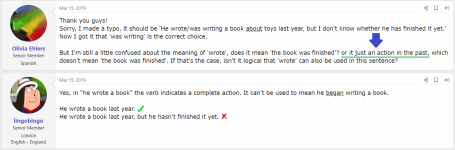
I don't think it's only the Russian thing. I've seen people of other nationalities ask similar questions. As an example (link):
wrote a book.png
 
  • "They planned their escape for many months."
If we put this sentence into the passive voice, it would be,
  • "Their escape was planned for many months",
    which in turn, I believe, means,
  • "Their escape plan was done(ready) for many months".
Not necessarily.
 
They worked on their escape for that long. It was in the planning stages for that period of time.
 
Here's what I was trying to understand:
  • "They planned their escape for many months."
If we put this sentence into the passive voice, it would be,
  • "Their escape was planned for many months",
    which in turn, I believe, means,
  • "Their escape plan was done(ready) for many months".

I see what you mean. In this passive version, yes, your interpretation is also possible, making it ambiguous.

It's like saying, "The food was (or) has been cooked for two hours".

Right.

Is 'cooked' here a continuous action lasting two hours, or is it the state of the food being cooked=done=ready?

Yes, it could be either. It's ambiguous.

Most -ed words are ambiguous—without enough context you can't tell whether it's an action or a state.
 
Last edited:
I don't find the sentence in the OP ambiguous at all:

For many months, they planned their escape.

At the same time, I agree that the related passive sentence is ambiguous:

For many months, their escape was planned.

However, the enduring-state reading of the passive there leans upon a stative interpretation of the passive (whereby was planned means was in a state of having been planned), and there is simply no way—not even by the most extreme contortions—that we can force that stative reading upon the dynamic verb phrase of the active-voice sentence. The sentence For many months, they planned their escape simply cannot mean For many months, they had their escape planned.
 
I'd also like to ask you about this
Planning here is a continuous action lasting many months. There's no clear sense of completion. The plan may or may not have been complete at the end of the period (though there is an implication that it was).
and this
You want to say They were planning their escape for many months. Am I right?
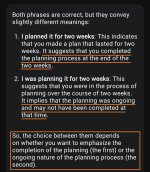
I asked ChatGPT this question and this is what it said (I'll underline some moments that differ from what you said):
58c76e72-d739-48f6-9d0b-9f4577b097f9.jpg

It describes the past continuous sentence in the way you described the original one, but the continuous tense is still not a good choice even to remove the ambiguity?

I'd like to point out that ChatGPT is contradicting itself when talking about sentence 1 (as it seems to me). First it says "This indicates that you made a plan that lasted for two weeks" which, by the way, was one of the two interpretations that I thought the sentence had:
... or that they had it planned (done!) for many months?
but then it says something different: that it's a planning process, though ending up completed at the end of that period.
 
The original sentence means "Over the course of many months, they carried out activities that were necessary for a successful escape".

If "many months" referred to the finished plan, it would say "They finished planning their escape many months ago" or "They planned their escape many months ago".

If they haven't yet escaped, it would say "They have been planning their escape for many months".

If they have now escaped, it would say "They had been planning their escape for many months".

There's a difference between "to plan + noun" and "to plan + to-infinitive".
 
This conversation seems to be going nowhere. They wanted to escape. It took a while to plan it. In fact, it took several months. There!
 
First of all, it seems to me that ChatGPT is contradicting itself when talking about sentence 1. First it says "This indicates that you made a plan that lasted for two weeks" which, by the way, was one of the two interpretations that I thought the sentence had:
... or that they had it planned (done!) for many months?
but then it says something different: that it's a planning process, though ending up completed at the end of that period.

I can't see anything there that contradicts anything I said.
About the difference between what you and ChatGPT said. It described the past continuous sentence in the way you described the original one (which is in the past simple). You can see that above, "This suggests that you were in the process of planning over the course of two weeks. It implies that the planning was ongoing and may not have been completed at that time". About the past simple sentence, it said that it suggests that the plan was completed by the end of that period of time, while you said, "Planning here is a continuous action lasting many months. There's no clear sense of completion. The plan may or may not have been complete at the end of the period (though there is an implication that it was)."

Once again, to summarize in a simpler form: your description of the original sentence in the past simple is the same as the one that ChatGPT gave to the past continuous sentence. At the same time, the description ChatGPT gave to the past simple sentence differs from yours.
 
I suggest you largely ignore ChatGPT's advice on grammar. It's been well documented in other forum threads that the answer you receive from ChatGPT on grammar depends largely on how one poses the question. Pose the question in a slightly different way, and you'll get different or conflicting advice, as you stated.

At least one thread dealt with ChatGPT suggesting a blatantly ungrammatical construction was simply "less commonly used", until the OP rephrased the question, whereupon ChatGPT then suggested it was ungrammatical.

Remember that AI merely pulls information from the internet, and the internet is full of incorrect and conflicting information. There are numerous grammatical points where human experts disagree or hold different views, so AI can only rehash those opinions.
 
I have never used ChatGPT. Should I start? 😊
 
About the difference between what you and ChatGPT said. It described the past continuous sentence in the way you described the original one (which is in the past simple). You can see that above, "This suggests that you were in the process of planning over the course of two weeks. It implies that the planning was ongoing and may not have been completed at that time".

Okay, but I haven't said anything about any past continuous sentence. The sentence in question is in the past simple.

About the past simple sentence, it said that it suggests that the plan was completed by the end of that period of time, while you said, "Planning here is a continuous action lasting many months. There's no clear sense of completion. The plan may or may not have been complete at the end of the period (though there is an implication that it was)."

No, ChatGPT is saying the same thing as me here. When it says "it suggests ...", that's the same as when I say "there's an implication that it was (complete). Suggesting and implying are the same thing.

Once again, to summarize in a simpler form: your description of the original sentence in the past simple is the same as the one that ChatGPT gave to the past continuous sentence.

Yes. Both past simple and past continuous are the same with respect to the interpretation that planning happened over a period of time.

At the same time, the description ChatGPT gave to the past simple sentence differs from yours.

No. What I'm saying and what ChatGPT is saying in number 1 are pretty much identical.
 
Okay, but I haven't said anything about any past continuous sentence.
I know you haven't! And I didn't say you had. But that was not the point, the point was that the description ChatGPT gave to the past continuous sentence is almost identical to the one you gave to the past simple one.

What I'm saying and what ChatGPT is saying in number 1 are pretty much identical.
You seem to be missing what ChatGPT said at the bottom:

"So, the choice between them depends on whether you want to emphasize the completion of the panning (the first) or the ongoing nature of the planning process (the second)."

while your words about the past simple sentence, the one ChatGPT referred to as "(the first)", were:

"Planning here is a continuous action lasting many months. There's no clear sense of completion. The plan may or may not have been complete at the end of the period (though there is an implication that it was)."

Now you see? It took us both a long time : )
 
Status
Not open for further replies.

Ask a Teacher

If you have a question about the English language and would like to ask one of our many English teachers and language experts, please click the button below to let us know:

(Requires Registration)
Back
Top
