
The river is too close to build the house here

Status
Not open for further replies.

Alexey86

Senior Member
Joined
Nov 3, 2018
Member Type
Student or Learner
Native Language
Russian
Home Country
Russian Federation
Current Location
Russian Federation
Suppose a friend of mine is going to build a house near a river and I warn him, "It's not a good idea to build the house this close to the river. There is a risk of flooding."

Would the following variants be grammatical and natural:

a)
"The river is too close to build the house here. There is a risk of flooding."
b) "The river is too close, so the risk of flooding is too high to build the house here."

I'm especially interested in the
noun + be + too + adjective + to + verb + noun pattern where the blue part modifies the first noun.
 
Last edited:
a) "The river is too close to build the house here. There is a risk of flooding."
That's correct and natural.

Neighbors down the road live in a house right on the river. High water threatens them every year, but it has yet to enter the house (except the basement). The closest it got was the year they moved in — 1963. It was lapping on the back steps that year. It got nearly that high this spring but stayed a foot or two away.

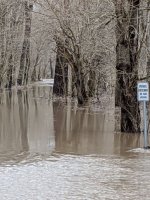
Then there are the neighbors a hundred yards further down. They had a bit of trouble navigating their driveway ….
IMG_20201126_3215.jpg
 
Or
It is risky is build the house on the land which is too close to the river and is prone to flooding.
 
Or
It is risky is build the house on [STRIKE]the[/STRIKE] land which is too close to the river and is prone to flooding.
See above.
 
It refers to a specific piece of land and not land in general.
 
It refers to a specific piece of land and not land in general.
You could get away with the article in a particular context. Would you care to construct a dialog demonstrating this?
 
Or
It is risky is build the house on the land which is too close to the river and is prone to flooding.

Too many words! All rivers overflow their banks from time to time and thus are prone to flooding.

The original sentence was perfectly good.

I bet GS can find a picture of a house on stilts.

(It was in 1973 that the Mississippi (technically the Mississippi-Missouri) had a 100-year flood that lasted all summer.)
 
You could get away with the article in a particular context. Would you care to construct a dialog demonstrating this?

It is a specific context as given in Post #1 - the house close to the river.
 
Last edited:
Too many words! All rivers overflow their banks from time to time and thus are prone to flooding.

The original sentence was perfectly good.

I bet GS can find a picture of a house on stilts.

(It was in 1973 that the Mississippi (technically the Mississippi-Missouri) had a 100-year flood that lasted all summer.)

It is not the river that is prone to flooding but the land beside the river.

And not all land beside a river is prone to flooding. It depends on their relative levels.
 
b) "The river is too close, so the risk of flooding is too high to build the house here."

b1) With the river so close, the risk of flooding is too great to build the house here.
 
It is not the river that is prone to flooding but the land beside the river.

You'll get an argument on that one.

And not all land beside a river is prone to flooding. It depends on their relative levels.

I wouldn't worry about a possible flood in that case.

~R
 
b1) With the river so close, the risk of flooding is too great to build the house here.

Thank you. I felt b) was a bit clunky. Is there any difference between 'with the river so close' and ' ...this close'?
 
How about: It is too risky to build the house on the land so close to the river (because of potential flooding).
 
Sometimes they build houses on stilts because of the flooding problem. I don't know if they're still there, but there were a couple in St. Louis near the river.
 
Sometimes they build houses on stilts because of the flooding problem. I don't know if they're still there, but there were a couple in St. Louis near the river.
There are several houses on stilts within half a mile of my place here in southwest Ohio. Lots of houses in New Orleans are on stilts now, after post-Katrina rebuilding.
 
Thank you. I felt b) was a bit clunky. Is there any difference between 'with the river so close' and ' ...this close'?

In this context, where "so close to the river" means "so close as this to the river," "so close to the river" and "this close to the river" are interchangeable.

I know you want to use, as you put it, "the noun + be + too + adjective + to + verb + noun pattern," which is fine, but I prefer the following:

With the river this close, there is too great a risk of flooding to build the house here.
 
Suppose a friend of mine is going to build a house near a river and I warn him, "It's not a good idea to build the house this close to the river. There is a risk of flooding." Would the following variants be grammatical and natural:

a)
"The river is too close to build the house here. There is a risk of flooding." b) "The river is too close, so the risk of flooding is too high to build the house here."

I'm especially interested in the
noun + be + too + adjective + to + verb + noun pattern where the blue part modifies the first noun.

They are both acceptable, but b) would be better formulated as:

The river is so close that the risk of flooding is too high to build the house here.

Here, the underlined content clause is licensed by the "so" that modifies "close".

Incidentally, the adjective phrase in a), too close to build the house here, is not modifying "river" but is predicative complement of "be".
 
How about no colon here "It is too risky to build the house on [STRIKE]the[/STRIKE] land so close to the river (because of potential flooding)"?

Note my corrections above.
 
Status
Not open for further replies.

Ask a Teacher

If you have a question about the English language and would like to ask one of our many English teachers and language experts, please click the button below to let us know:

(Requires Registration)
Back
Top