The usage of "there is the"

Status
Not open for further replies.
We can now see that you're trying to understand things in terms of what the listener knows about. Where did you get this idea from? I suggest you put it aside right away. It doesn't help explain anything. If I point at something, I don't necessarily need you as a listener to have prior awareness of the thing's existence.
I was taught this idea by quite a few people including natives. Can you substantiate your appeal to put it aside? If I put it aside how can I explain the difference:

Bring me a book.
Bring me the book.

Of course, it doesn't cover all the possible cases. But this is a basic case.
 
That is a different situation, similar to the "There was the long drive home, the long drive and the warm dark and the pleasant closeness of the hansom cab with its insulation from the world devised by some great and good man" that we discussed earlier.
There are two brothers. One eats semolina porridge only, the other eats either semolina porridge or buckwheat porridge. The one who eats semolina is John, the other is Jack. One day you pay them a visit and see them eating semolina porridge. How would you understand which one of them is Jack?
He that hath ears to hear, let him hear.
 
If I put it aside how can I explain the difference:

1. Bring me a book.
2. Bring me the book.
1. Bring me a book, any book.
2. Bring me a specific book, one to which previous reference has been made, or one which is the only book around.
 
1. Bring me a book, any book.
2. Bring me a specific book, one to which previous reference has been made, or one which is the only book around.
So, a previous reference reveals the fact that the speaker knows the book or about the book.
 
Yes - the speaker, not the person addressed.
 
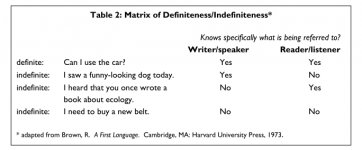
I use this system sometimes. It works.
 

Attachments

  • Matrix_of_Definiteness.jpg
    Matrix_of_Definiteness.jpg
    69.5 KB · Views: 10
Say:

This is the book my parents gave me.

I can't imagine using "which" there, and I wouldn't expect to hear it.
 
I was taught this idea by quite a few people including natives. Can you substantiate your appeal to put it aside?

Oh, yes, sure. The fact that it doesn't satisfactorily explain what you need explaining should be more than a sufficient reason. You can explain some cases with this idea, yes, but far from all. This is exactly your point, right? So there must be something insufficient on a deeper level with such an explanation.

Look, ROFTOK, I've been trying to explain definite and indefinite noun phrases to Russian speakers for many years (as has I presume 5jj). If you want me to try to do so with you, I'm happy to, but to do that I need to know exactly what you already think you know, so I can tell you where you're wrong. The biggest obstacle to understanding for Russian speakers is often undoing all of the bad teaching and imprecise rules that they've been previously exposed to.
 
Oh, yes, sure. The fact that it doesn't satisfactorily explain what you need explaining should be more than a sufficient reason. You can explain some cases with this idea, yes, but far from all. This is exactly your point, right? So there must be something insufficient on a deeper level with such an explanation.

Look, ROFTOK, I've been trying to explain definite and indefinite noun phrases to Russian speakers for many years (as has I presume 5jj). If you want me to try to do so with you, I'm happy to, but to do that I need to know exactly what you already think you know, so I can tell you where you're wrong. The biggest obstacle to understanding for Russian speakers is often undoing all of the bad teaching and imprecise rules that they've been previously exposed to.
There was a sentence: There's the oddest-looking man standing at the front door!

In what context can it be used?

A person notices this man and shouts: "Look! There's the oddest-looking man standing at the front door!"

Would it be grammatically correct to use "A"
There's an oddest-looking man standing at the front door!

Would that mean that "there is always an oddest-looking man at the front door"?
 
No. For a start, "oddest" is a superlative so there can't be more than one. It's a bit like saying "There's the oddest-looking man I've ever seen". The indefinite article would be fine with the adjective or the comparative.

There's an odd-looking man at the front door.
There's an odder-looking man at the back door!

That's the same for all levels of adjective. Let's say you're describing some of the kids in a classroom and their position.

A tall boy is standing by that table.
A taller boy is standing behind him.
The tallest boy is sitting on a stool.
 
In this case it's probably not used in the superlative sense. In fact, it almost certainly isn't. (See below.)

Jane: Hey Sarah! There's the oddest looking man standing at the front door.
Sarah: Hey! That's my dad!
 
In this case it's probably not used in the superlative sense. In fact, it almost certainly isn't. (See below.)

Jane: Hey Sarah! There's the oddest looking man standing at the front door.
Sarah: Hey! That's my dad!
What are you suggesting it is then? "Oddest" has one definition - the superlative of the adjective "odd".
 
Perhaps it's exclusively North American, but we use non-existent superlatives like "oddest" frequently for emphasis. "Joe has the weirdest laugh" isn't really comparing Joe's laugh to anyone elses. It's just saying that Joe's laugh is very unusual.
 
What are you suggesting it is then? "Oddest" has one definition - the superlative of the adjective "odd".
Well, maybe it's an Americanism. It's common enough here (USA). For example, if I heard somebody say "There's the funniest looking guy at the front door" I wouldn't think they're comparing him to other funny looking guys. They're just saying he's odd-looking. In form, yes, it's a superlative. But they're not saying that of all the odd-looking people he's the oddest looking.

There is another expression: "It's just an expression."
 
Perhaps it's exclusively North American, but we use non-existent superlatives like "oddest" frequently for emphasis. "Joe has the weirdest laugh" isn't really comparing Joe's laugh to anyone elses. It's just saying that Joe's laugh is very unusual.
Fine, but I don't think you say "Joe has an oddest laugh"
 
That's the same for all levels of adjective. Let's say you're describing some of the kids in a classroom and their position.
Do you have a best friend?
This is a most interesting book I read last month.
 
This is the most interesting book I read last month.
I'm starting to realize how hard this is to explain. As a native speaker, I know this stuff intuitively. The challenge is making it explicit. (It's a bigger challenge sometimes than others.)
 
Status
Not open for further replies.

Ask a Teacher

If you have a question about the English language and would like to ask one of our many English teachers and language experts, please click the button below to let us know:

(Requires Registration)
Back
Top